

Document Camera
The Document Camera component provides a live camera interface for capturing identity documents. It includes real-time feedback, auto-capture, and customizable UI elements.
Theming
Section titled “Theming”The component automatically follows the host device/browser’s prefers-color-scheme setting — no configuration needed. Dark mode (the default look) uses a navy background with white text/icons; light mode inverts to a white background with navy (#000D1A) text/icons.
Properties
Section titled “Properties”Core Properties
Section titled “Core Properties”-
isOpen: Boolean
Starts or stops the camera. Whentrue, the camera feed and UI are rendered. Automatically set tofalseafter capture or error. -
showBackButton: Boolean
Controls the visibility of the back button that allows users to exit the camera. Default:true. -
showHelpIcon: Boolean
Controls the visibility of the Help icon. Default:true. -
toggleAutoCaptureDelay: Number (milliseconds)
Delay before enabling the Auto Capture toggle after the initial animation completes. Default:15000(15s). -
showBackOfDocumentAnimation: Boolean
Iftrue, shows the back-side animation first. Default:false. Caller-owned — the component never resets it, so set it back tofalsebefore starting a new document or the back-side animation persists into the next front-side capture. -
successTime: Number (milliseconds)
How long the “photo taken” success overlay is shown after a capture, before the preview screen (or, ifshowPreviewScreenisfalse, thecaptureevent) follows. Default:1500. -
showPreviewScreen: Boolean
Controls whether the post-capture preview screen (review/retake/end) is shown before dispatchingcapture. Whenfalse(the default),capturedispatches and the camera closes immediately after the success overlay, skipping the preview screen entirely. Opt in per integration — coordinate with your team before enabling, since it changes whencapture/closefire. Default:false. -
autoCaptureTimeout: Number (milliseconds)
Timeout duration for auto-capture. Must be greater thantoggleAutoCaptureDelay. Default:60000(1 minute). -
enableAutoCaptureTimeout: Boolean
Enables or disables auto-capture timeout functionality. Default:true. -
enableAutoCapture: Boolean
Enables auto-capture as the launch mode. Whentrue, the camera opens in auto-capture and (subject toenableAutoCaptureTimeout) the auto-capture timeout is armed. Default:true. As an HTML attribute useenable-auto-capture; removing the attribute restores the default. -
enableTapToCapture: Boolean
Makes tap-to-capture available. WhentrueandenableAutoCaptureisfalse, the camera launches directly in tap-to-capture mode with the capture button shown immediately, and the auto-capture timeout is ignored. Default:true. As an HTML attribute useenable-tap-to-capture; removing the attribute restores the default. -
documentType:'auto' | 'id' | 'passport'Selects capture guidance and AssureID DPI gating for ID cards or passports. Default:'auto'. Inauto, the SDK infers ID vs passport from the detected document aspect ratio; explicitidorpassportvalues override inference.In
automode, the visible reticle intentionally remains passport-shaped for the duration of the session. This keeps the capture guide visually stable while document-type inference settles and prevents the reticle from changing shape mid-capture. The capture pipeline still uses the inferred document type internally for guidance and AssureID DPI gating.
Capture Mode Behaviour
Section titled “Capture Mode Behaviour”enableAutoCapture and enableTapToCapture together determine which mode the camera launches in and whether the user can switch modes:
enableAutoCapture |
enableTapToCapture |
Launch mode | Auto-capture toggle | Auto-capture timeout |
|---|---|---|---|---|
true |
true |
Auto-capture | Shown after toggleAutoCaptureDelay |
Armed (respects enableAutoCaptureTimeout) |
true |
false |
Auto-capture | Never shown | Armed (respects enableAutoCaptureTimeout) |
false |
true |
Tap-to-capture | Shown immediately (user can switch to auto-capture) | Ignored |
false |
false |
Auto-capture | Shown after toggleAutoCaptureDelay |
Armed |
Setting both to false is a misconfiguration and is normalized to the default (both enabled) behaviour.
Detection Feedback
Section titled “Detection Feedback”-
hints: DocumentDetectionHint
Customizes user guidance messages used by detection feedback. Any fields you omit fall back to sensible defaults. -
cameraState: CameraState (read-only)
Indicates the current detection state, e.g.,MoveCloser,OutOfFrame,FixGlare,FixBlur,Countdown,Capturing,TapToCapture.
Text Customization
Section titled “Text Customization”The Document Camera component provides text and accessibility customization to support internationalization and accessibility.
Text precedence for visible copy:
texts(provided keys)- Component defaults
ARIA label precedence:
ariaLabels(provided keys)- Component defaults
-
texts: Object
Overrides user-facing copy. Recognized keys:autoCaptureTextautoCaptureOnTextautoCaptureOffTextcleanLenseTextphotoCapturedText
-
ariaLabels: Object
Supplies ARIA labels for interactive controls. Recognized keys:backButtonhelpIconautoCaptureEnableautoCaptureDisabletapToCapturecloseHelpButtonhelpSection
-
generalInfoTexts: [String, String, String]
Text shown in the general information section.
First string: smart capture instructions (front of document).
Second string: tap-to-capture instructions (front of document).
Third string: instructions shown whileshowBackOfDocumentAnimationistrue, regardless of capture mode. -
textsHelpSection: Object
Overrides the help panel text. Recognized keys:titlebody(front of document)bodyBack(shown instead ofbodywhileshowBackOfDocumentAnimationistrue)lightingTipTextframingTipTextsteadyTipTextautoCaptureConfirmationTextstrugglingTextcloseHelpAltText
-
previewScreenTexts: Object
Overrides the post-capture preview screen (shown after a photo is taken, before the result is returned). Recognized keys:titlebodyphotoAltTextexamplesLinkTextcontinueButtonTextretakeButtonTextendCheckButtonTextgoodLabelgoodCaptionbadLabelcornersCaptioncoveredCaptionblurryCaptionglareCaption
-
previewScreenAriaLabels: Object
Supplies ARIA labels for the preview screen’s buttons, independent ofpreviewScreenTexts. Recognized keys:examplesLinkcontinueButtonretakeButtonendCheckButton
-
cancelConfirmationTexts: Object
Overrides the “End identity check” confirmation modal, opened from the preview screen’s End button. Recognized keys:titleconfirmButtonTextdismissButtonText
-
cancelConfirmationAriaLabels: Object
Supplies ARIA labels for the “End identity check” confirmation modal’s buttons, independent ofcancelConfirmationTexts. Recognized keys:confirmButtondismissButton
-
qualityExamplesTexts: Object
Overrides the good/bad quality examples screen, opened from the preview screen’s examples link. Recognized keys:titlegoodLabelgoodCaptionbadLabelcornersCaptioncoveredCaptionblurryCaptionglareCaptioncloseAltText
Localization Example
Section titled “Localization Example”All visible text and ARIA labels can be set at once to switch the UI to another language. Only provide the keys you want to override — any omitted keys fall back to the component defaults.
const documentCamera = document.getElementById('live-document-camera');
// Visible copydocumentCamera.texts = {  autoCaptureText: 'Auto Capture',  autoCaptureOnText: 'ON',  autoCaptureOffText: 'OFF',  cleanLenseText: 'Make sure your camera lens is clean and hold the device steady',  photoCapturedText: 'Photo captured'};
// Accessibility labels (ARIA)documentCamera.ariaLabels = {  backButton: 'Back',  helpIcon: 'Open help',  autoCaptureEnable: 'Enable auto capture',  autoCaptureDisable: 'Disable auto capture',  tapToCapture: 'Tap to Capture',  closeHelpButton: 'Close help',  helpSection: 'Help section.'};
// Detection hintsdocumentCamera.hints = {  moveCloserHint: { title: 'Document is too far', description: 'Fit your document fully within the frame.' },  fixBlurHint: { title: 'Document is blurry', description: 'Clean your camera lens & hold your phone still' },  fixGlareHint: { title: 'Glare detected', description: 'Move away from bright light' },  outOfFrameHint: { title: 'Document not in frame', description: 'Position your whole ID inside of the frame' },  capturingHint: { title: 'Document detected', description: 'Capturing...' }};
// General instructions (index 0 = auto-capture, index 1 = tap-to-capture, index 2 = back of document)documentCamera.generalInfoTexts = [  'Position the PHOTO PAGE of your document within the frame below',  'Position your identity document within the frame',  'Position the PHOTO PAGE of your document within the frame below'];
// Help paneldocumentCamera.textsHelpSection = {  title: 'How to take a photo of your identity document',  body: 'Place your document PHOTO PAGE up on a flat surface and:',  bodyBack: 'Place your document PHOTO PAGE up on a flat surface and:',  lightingTipText: 'Use a well lit area but avoid any strong overhead lighting',  framingTipText: 'Fill the entire frame with your document',  steadyTipText: 'Hold your phone steady',  autoCaptureConfirmationText: 'Once the picture is clear, we’ll automatically take a photo',  strugglingText: 'Still struggling to take a photo, turn off Auto capture',  closeHelpAltText: 'Close help'};
// Preview screen (shown after a photo is taken)documentCamera.previewScreenTexts = {  title: 'Check the preview of your identity document',  body: 'Check the photo of your document is clear, in focus and directly face on.',  photoAltText: 'Preview of your captured identity document',  examplesLinkText: 'Examples of good and bad quality photos',  continueButtonText: 'Continue',  retakeButtonText: 'Take another photo',  endCheckButtonText: 'End identity check',  goodLabel: 'Good',  goodCaption: 'Photo is clear, in focus, and directly face on.',  badLabel: 'Bad',  cornersCaption: 'Photo must show all four corners.',  coveredCaption: 'Document must not be covered.',  blurryCaption: 'Photo must not be blurry.',  glareCaption: 'Photo must not have glare.'};
// Preview screen ARIA labels (independent of previewScreenTexts)documentCamera.previewScreenAriaLabels = {  examplesLink: 'Examples of good and bad quality photos',  continueButton: 'Continue',  retakeButton: 'Take another photo',  endCheckButton: 'End identity check'};
// "End identity check" confirmation modal (opened from the preview screen)documentCamera.cancelConfirmationTexts = {  title: 'Are you sure you want to end your identity check?',  confirmButtonText: 'Yes',  dismissButtonText: 'No'};
// Confirmation modal ARIA labels (independent of cancelConfirmationTexts)documentCamera.cancelConfirmationAriaLabels = {  confirmButton: 'Yes',  dismissButton: 'No'};
// Good/bad quality examples screen (opened from the preview screen)documentCamera.qualityExamplesTexts = {  title: 'Examples of good and bad quality photos',  goodLabel: 'Good',  goodCaption: 'Photo is clear, in focus, and directly face on.',  badLabel: 'Bad',  cornersCaption: 'Photo must show all four corners.',  coveredCaption: 'Document must not be covered.',  blurryCaption: 'Photo must not be blurry.',  glareCaption: 'Photo must not have glare.',  closeAltText: 'Close'};
Lifecycle Overview
Section titled “Lifecycle Overview”The Document Camera component provides a streamlined capture flow optimized for identity document scanning with real-time quality feedback.
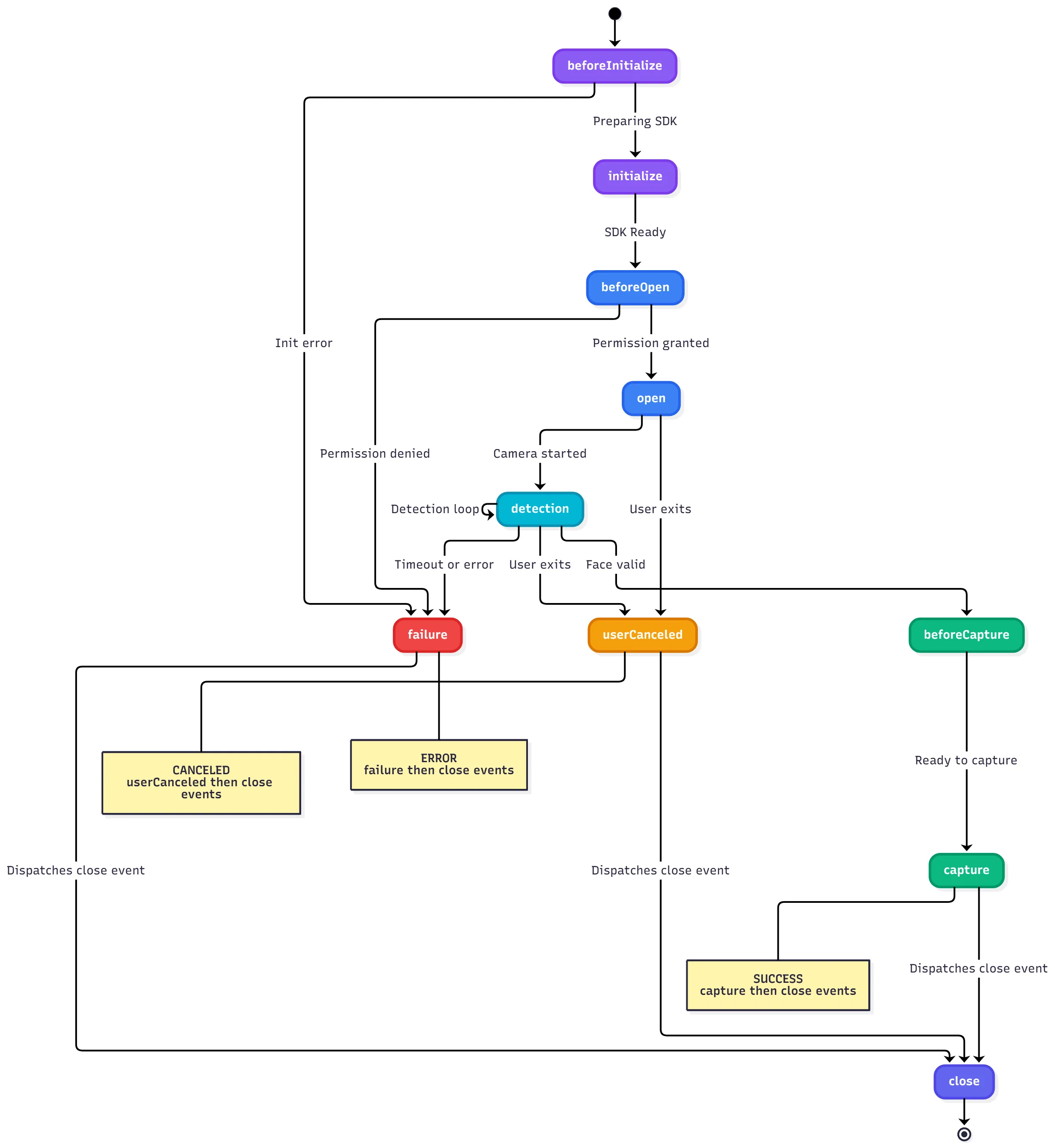
Key Flow Stages:
- open: Camera initialized and WebRTC stream established
- detect loop: Continuous frame analysis checking for glare, blur, angle, DPI
- capture: When quality thresholds are met (auto) or user taps (manual). The “photo taken” success overlay shows for
successTimems. - preview (optional, opt-in): The camera hardware releases and the user reviews the photo, with the option to Continue, Retake, or End the identity check. Only happens when
showPreviewScreenis set totrue— see the Core Properties section. - close: Camera closes and cleanup. The
closeevent is always emitted aftercapture,userCanceled,failure, or timeout.
Events
Section titled “Events”-
OpenEventName
Triggered when the camera starts. -
CloseEventName
Triggered when the camera stops. This event is always emitted, regardless of how the camera session ends (successful capture, user cancellation, error, or timeout). After a successful capture, thecaptureevent is dispatched first, followed by thecloseevent. -
UserCanceledEventName
Triggered when the user exits the document camera without the flow completing normally — either by clicking the back arrow before capturing, or by choosing “End identity check” from the preview screen after a successful capture (seeshowPreviewScreen).detaildoes not distinguish between these two cases. Thecloseevent is dispatched after this event. -
FailureEventName
Triggered on error.detail.erroris of typeDocCameraError. Thecloseevent is dispatched after this event. -
CaptureEventName
Triggered on successful capture.detail.captureResponsecontains capture data. Thecloseevent is dispatched after this event. -
DetectEventName
Triggered on each frame detection.detailincludesdetectResponseandcameraState.
Example Usage
Section titled “Example Usage”Basic Setup
Section titled “Basic Setup”<live-document-camera id="live-document-camera" autoCaptureTimeout="120000" enableAutoCaptureTimeout="true"></live-document-camera>Launching in Tap-to-Capture Mode
Section titled “Launching in Tap-to-Capture Mode”<live-document-camera id="live-document-camera" enable-auto-capture="false" enable-tap-to-capture="true"></live-document-camera>Or in JavaScript:
const camera = document.getElementById('live-document-camera');camera.enableAutoCapture = false;camera.enableTapToCapture = true;Handling Timeout Error
Section titled “Handling Timeout Error”const camera = document.getElementById('live-document-camera');
camera.addEventListener(LiveDocumentCamera.FailureEventName, (event) => { const error = event.detail.error;
if (error.code === 'auto-capture-timeout') { // Handle timeout - e.g., show message to user console.log('Auto-capture timed out. Please use manual capture or offer to retry.'); }});Type Definitions
Section titled “Type Definitions”type DocumentDetectionHint = { moveCloserHint?: DocumentHint; fixBlurHint?: DocumentHint; fixGlareHint?: DocumentHint; outOfFrameHint?: DocumentHint; capturingHint?: DocumentHint;};
type DocumentHint = { title: string; description: string;};
type DocCameraError = { code: string; message: string;};
type CaptureResponse = { isGood?: boolean; isSharp?: boolean; isGlareFree?: boolean; isAdequateDpi?: boolean; isPortraitOrientation?: boolean; failedChecks?: string[]; imageData?: ImageData; imageWidth?: number; imageHeight?: number;};
type DetectResponse = { isGood: boolean; isSharp?: boolean; isGlareFree?: boolean; isAdequateDpi?: boolean; failedChecks: string[]; dimensions?: Dimension; corners?: MappedCorners;};
type Dimension = { width: number; height: number;};
type MappedCorners = { topLeft: Corner; topRight: Corner; bottomLeft: Corner; bottomRight: Corner;};
type Corner = { x: number; y: number;};
enum CameraState { MoveCloser, OutOfFrame, FixGlare, FixBlur, Countdown, Capturing, TapToCapture}